How To Keep Your Grass Healthy During Water Restrictions
Keeping your grass healthy during water restrictions can seem nearly impossible. But, lucky for homeowners, there are a number of things you can do in order to keep your grass healthy while your city or state government has imposed water restrictions. From mowing techniques to the types of fertilizer you use, limiting the water intake your lawn experiences doesn’t mean it has to be unhealthy. In this post from The Grass Outlet blog, we’ll discuss some ways to keep your grass healthy during water restrictions.
Mow Your Grass High Using Sharp Blades
Grass that is best suited for warm seasons tends to be thicker during the summer, as the warm weather leads to increased growth rates. It’s important to keep your mower blades as sharp as possible so it’s capable of cutting your grass even in this extra dense state. Additionally, by mowing your grass with sharp blades, you’re able to give it an instant boost in appearance due to the efficiency of the mower.
Furthermore, during the summer, you should keep your grass on the taller end of the recommended grow height of your particular variety. Taller leaves result in deeper roots, and deeper roots have the ability to access water that is stored deep in the soil, which is essential for good health during warm weather. Another reason you should keep your grass taller during the summer is that mowing the lawn stresses it further, as it will already be under stress due to the hot weather. By keeping your grass tall, you can also keep your soil cooler, which helps the roots below thrive.
Proper Irrigation Techniques
Much of Texas spends the summer under water restrictions after long stretches of triple-digit heat with little rain. Depending on your city’s current drought stage, your irrigation, sprinklers, or hoses may only run at certain hours on certain days based on your address — and because those stages change through the season, always check your current restrictions with your local water provider (Austin Water for the Austin area, or SAWS for San Antonio) before setting your schedule. Keeping your irrigation system in top operational order matters even more when every drop counts.
You should also irrigate based on your soil type, your soil condition, and local weather. It’s worth considering the 5 S’s of your lawn — soil, shade, slope, species, and season — within each irrigation zone when determining the best runtime for your yard and sprinkler heads. You’ll get the most from your system by watering in the early morning hours (around 2–9 AM), when wind speeds are lower and evaporation is less likely. Read our irrigation guide to determine the proper schedule for your yard.
Take Advantage of Grass Clippings
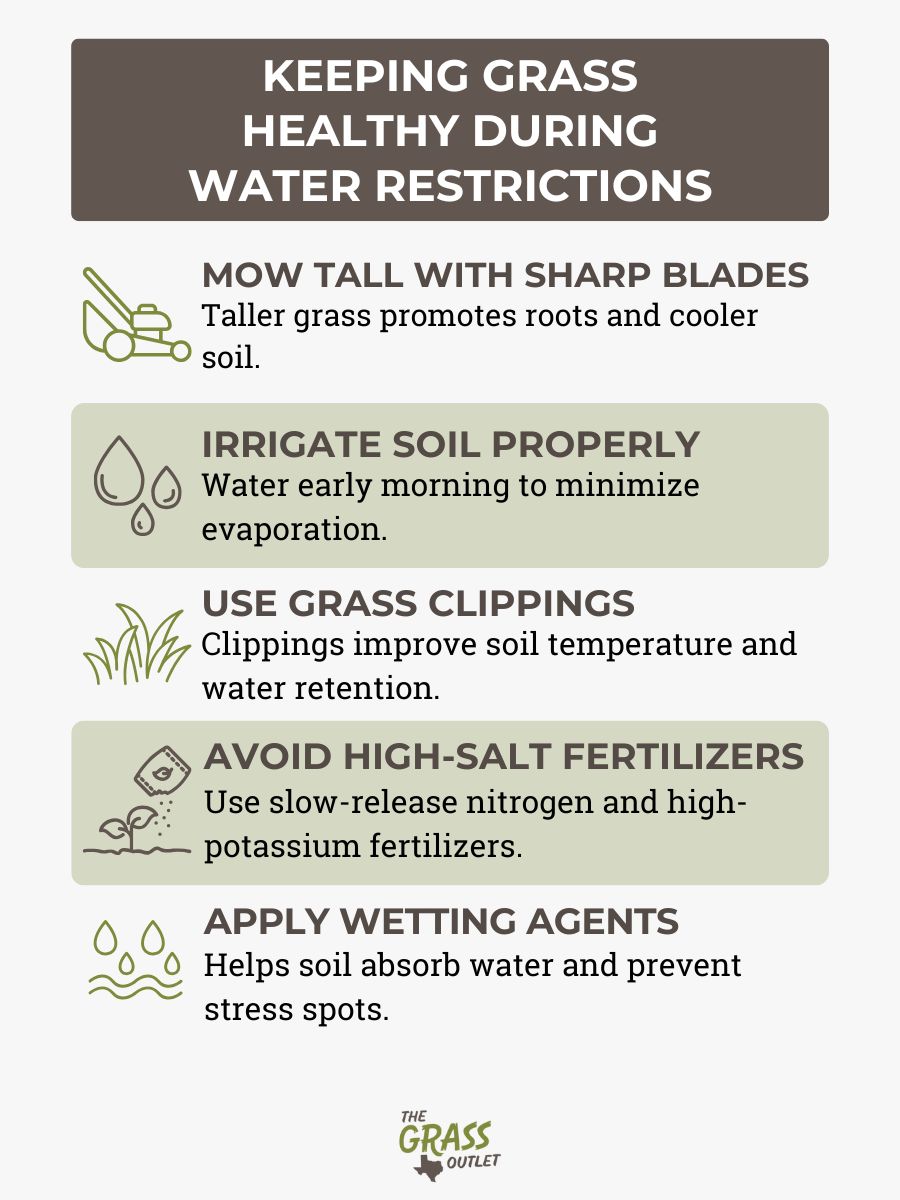
There are more negative effects of the dry spell on your lawn than just the lawn heat stress that comes with high temperatures and drought. Not only is water an essential medium for nutrient intake, but the lack of water can also result in higher soil temperatures. This, in turn, affects the SOM – or soil organic matter – decomposition, increasing the release of carbon dioxide. Grass clippings can assist in reducing the temperature of your soil by simply leaving them on your lawn. Leaving grass clippings on the lawn can reduce soil temperature, increase infiltration of water into the soil, improve the water storage capacity of the lawn, and help slow down organic matter mineralization. Be advised that grass clippings must be evenly distributed across the lawn. Dense clumps of clippings can block out essential sunlight and choke out your grass.
Avoid High-Salt Fertilizers
High-salt fertilizers can burn your lawn when it’s already suffering due to the high temperature of the sun. If your soil has been tested, and it’s discovered that it’s in need of nutrients, you should use a summer-friendly, slow-release nitrogen fertilizer, as fast-release nitrogen will burn your already stressed lawn. Ensure that you carefully read the label, and follow all of the instructions, especially regarding “watering in” the product. It’s also important to not over-fertilize your lawn, as over-fertilized lawns almost always use much more water. Finally, if you do decide to fertilize your lawn, look for a higher third number (potassium content) that will strengthen roots and and generally improve the grass’s health, helping it stand up to stress and drought better.
Consider Applying A Wetting Agent
If there are some areas of the soil that are unable to properly absorb water, it can result in stress spots all throughout the lawn. Though this is not a cure-all solution, a wetting agent can be beneficial in helping the water infiltrate the soil. It should be noted that a wetting agent will only assist when the soil is in a hydrophobic state, meaning that it repels water instead of absorbing it. If you notice that water is beading on the surface of your soil, a wetting agent is a great solution.
Choose a Drought-Tolerant Grass
When water is limited, the grass you plant matters as much as how you water it. Some Texas grasses are simply built to thrive on far less. Density Buffalo is the most drought-tolerant grass we carry — a full-sun Texas native that, once established, needs little to no supplemental water and can often survive on rainfall alone. Bermuda and Zoysia are strong drought-tolerant options too, while St. Augustine is the thirstiest and the hardest to keep healthy under restrictions. If you’re facing ongoing water limits, switching to a water-wise variety like Buffalo can make restrictions far easier to live with.
Watering Rules in San Antonio and Austin
If you’re in San Antonio, water restrictions aren’t just a dry-summer thing — SAWS enforces year-round watering rules, with tighter limits during drought stages. That makes your grass choice and watering habits matter even more. Check your current SAWS watering stage and allowed watering days before you set your schedule, lean on deep-and-infrequent watering, and consider a low-water native like Buffalo if you’re re-sodding. The less your lawn depends on the hose, the less restrictions will affect it.
Is Your Grass Beyond Repair?
If the heat has pushed your lawn past saving, sometimes the smartest water-saving move is starting fresh. At The Grass Outlet, we grow drought-tough Texas grasses that handle the summer heat — including low-water, native Buffalo. Not sure what you need? Give us a call and we’ll help you choose.
Shop Fresh Sod